
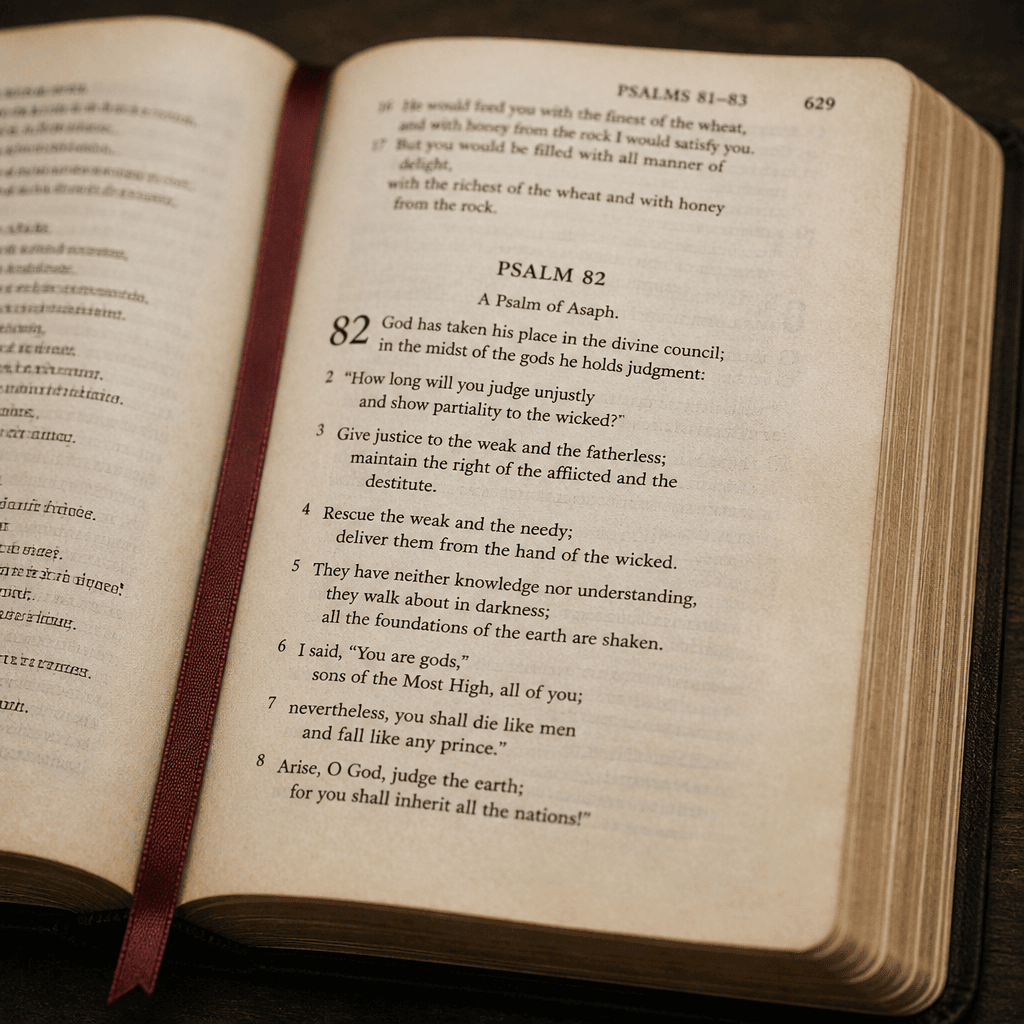
““I said, ‘You are “gods”; you are all sons of the Most High.’” Psalms 82:6 NIV
I remember the first time I heard a sermon on this verse. I was at the university at that time. “Christians are gods”, he said! I moved from utter shock to intrigued to happiness, I think, in the space of the 60 or so minutes of the sermon. Utter shock at the beginning because I had never heard anyone say those words, let alone that a Bible verse actually says those words. I grew up in a Christian home, and had also come to faith myself, 6 or so years earlier, but never heard of the verse. I remember saying to myself, ” Ah, this is the heresy my parents warned me about!” “There’s no way he can substantiate his claim,” I muttered to myself. But then, the preacher turned to this verse, and there it was, and there I was too, moving slowly from utter shock at the “heresy” to intrigue as I paid serious attention to his exposition of the verse. By the end of the sermon, I think, I can’t remember well now, but I think I was happy that I was a god. He had explained the verse well.
A god, even if it is lowercase “g” is a big deal, I thought. Now, like God, I can do the things I thought I couldn’t do, he said. In the sermon, he had also said that when God said, ‘you are gods,’ He was revealing my true identity. I am not merely human. I am a god in this world, created to function like God.” He said I shouldn’t be afraid to say those words to myself, because they are true words. Why didn’t anyone teach me this earlier, I thought? Boy, was I happy to have listened to this sermon.
I bet most, if not all of you, have heard a sermon on Christians are gods, and although the sermons don’t all follow the same pattern of application, I want to believe we have all heard and it probably produced similar reactions.
The Different Interpretations of Psalm 82:6
It’s also important to say that some of the sermons on this verse are more hardline in their application, and some are lighter/moderate. Some do not make strong statements like the sermon I heard; they explain the text along the lines of “If God calls you a god, who are you to call yourself ordinary?” They land in applications that help Christians to see that they are designed to live above natural limitations. Others, still moderate, say the verse teaches Christians that they are just like God in creative power. Christians can shape their reality the same way God did, with our words; we can speak in faith, move mountains, can’t get sick, etc., but they generally avoid saying “you are a god”. Those who tow these last two lines of application often disagree slightly with the application I heard from the sermon I listened to. They are more cautious. They don’t like the way “you’re a god in this world” sounds, and I am not sure why. Because both the hard and moderate applications, at the very least, have to assent to the meaning of the verse being that “Christians are gods”, that “they carry God’s DNA”. Otherwise, even their own moderate application would not hold. So, I am not sure why there is any disagreement in the camps at all.
I do sympathize with the moderate application guys. I see the reason for the caution. It does sound a bit off to say, “Christians are gods”. But if the verse means just that, I think they should go with it and just say it. If they “don’t stop talking it”, they will eventually be comfortable with it.
Does John 10:35 Prove Christians Are Gods?
But there are some others who don’t even agree with this explanation of the text. They don’t see how this verse means Christians are gods. They say the church needs to look at the whole psalm to know the identity of the “gods” in verse 6 and not be too quick to assume it’s Christians.
But shouldn’t we tell these “others” that Jesus confirmed this meaning in John 10:35?
Here is where it gets interesting. They know all about John 10:35, and they still disagree.
Let me summarize what they say by first quoting Jesus’ words so you can follow closely: John 10:31-36 NIV
“Again his Jewish opponents picked up stones to stone him, but Jesus said to them, “I have shown you many good works from the Father. For which of these do you stone me?” “We are not stoning you for any good work,” they replied, “but for blasphemy, because you, a mere man, claim to be God.” Jesus answered them, “Is it not written in your Law, ‘I have said you are “gods” ’? If he called them ‘gods,’ to whom the word of God came—and Scripture cannot be set aside— what about the one whom the Father set apart as his very own and sent into the world? Why then do you accuse me of blasphemy because I said, ‘I am God’s Son’?”
Now, they say, look at the context. His Jewish opponents want to stone Him because He was a “mere man” claiming to be God (uppercase G). Jesus wasn’t claiming lowercase g, but the uppercase, the one for which the Old Testament approves of stoning. “The LORD is our God, and He is one”, says Deut 6:4. So if anyone claims to be Him, he should be stoned. That was the thinking of his opponents, and rightly so. But how does Jesus reply His opponents? Remember, they have stones in hand, and they just accused Him of blasphemy. If He doesn’t provide evidence that He is not blaspheming fast enough, the stones would come flying at His face. This is the context of John 10:31.
Here again are Jesus’ words in defence against their accusation: “Is it not written in your Law, ‘I have said you are “gods” ’? If he called them ‘gods,’ to whom the word of God came—and Scripture cannot be set aside— what about the one whom the Father set apart as his very own and sent into the world? Why then do you accuse me of blasphemy because I said, ‘I am God’s Son’?” (Emphasis mine)
Notice what Jesus is doing, He is quoting Ps 82:6 and interprets the identity of the “gods” to be those “to whom the word of God came”. Jesus is quoting this to His accusers, who think that the claim to divinity is unprecedented in their bible at that time. However, He still left the identity an open question. He could have said:
- If he called the believers in the Old Testament ‘gods,’ –and Scripture cannot be set aside–
- If he called those within Israel’s covenant community ‘gods,’ –and Scripture cannot be set aside–
- If he called mere men ‘gods,’ –and Scripture cannot be set aside–
He could have said it a hundred different ways, but He didn’t. His commentary on this verse isn’t seeking to help state the identity of the gods in Ps 82. He is, rather, using the psalm to say that His claim of divine sonship (John 10:29) does not necessarily involve blasphemy, since in the Old Testament, there are places where “some people” are called gods (Psalm 82:6). He leaves the identity of those who were called gods unspoken.
So, you see, they are right in this regard, at least in saying that Jesus’ use of Ps 82:6 neither supports nor denies the meaning any group ascribes to Ps 82:6. To understand what the verse means and who the “gods” are, one must look at the whole psalm. Because ultimately, a text cannot be made to say what its context does not allow, not even for Jesus the incarnate Word, and most definitely not for us. When someone misrepresents us we say, “that’s not what I meant”, “that was not the context”. We all instinctively know that context, in interpretation, is king.
Interpreting Psalm 82:6 in Context
In the 8 verses of this Ps 82, our English Bibles have the word “gods” at least two times. Once in verse 1 and then in verse 6. The NIV adds a third in v5.
The fact is, the identity of the “gods” has always been debated for centuries. As my friends would say, “a lot of ink has been spilled on this verse”, and there seems to be no consensus whatsoever. But one thing we should all agree on is that no plain reading of the psalms brings you to identify yourself with the “gods”. The scathing words of v6-7 should scare any of us and give us a rethink as to whether we would like to be identified with the “gods”. ““I said, ‘You are “gods”; you are all sons of the Most High.’ But you will die like mere mortals; you will fall like every other ruler.”” (Psalms 82:6-7 NIV). These words sound like a judgment in a court.
Why do I say that? Because I identify the “I” in “I said” of v6 to be the God of v1. V1 presents itself as a court: “God presides in the great assembly; he renders judgment among the “gods”” (V1). Most translations I know translate v1b in judgment language. So, I naturally, and we all should, see v6-7 as a sentencing. And I don’t know why I would want to identify with those whom God is sentencing in His wrath.
To buttress my point, look at the rest of the verses in chapter 82. I am going to intentionally quote from the KJV so you don’t say that it’s the “newer” translations that are misleading.
V2: “How long will ye judge unjustly, And accept the persons of the wicked? Selah.” The “ye” here being the “gods” he judges among in v1b.
V5: “They know not, neither will they understand; They walk on in darkness: All the foundations of the earth are out of course.” The “they” here still refers to the “gods” in v1. No other subject has been introduced. Our only options are God or gods (See v1). It is definitely not God. For one, He is singular and only the “gods” are in plural, so the “they” pronoun can only belong to them. And 1 John 1:5 tells us that God is light, and in him is no darkness at all. So, we have to rule Him out as the candidate for the “they” in verse 5. It is emphatically the “gods”, they are the ones walking in darkness.
So far, we see that what the psalm is saying is that these “gods” of v1, judge unjustly (v2), accept wicked persons (v2), lack knowledge and understanding (v5), and walk in darkness (v5). This is why, though they are children of the Most High (v6), God in His wrath is pronouncing a severe judgment upon them and “demoting” (more on this later) them to the status of men to fall and die like them (v7).
The article has been split into two for easier reading. The second part comes next week.

